
Introduction: The Essential Role of Barrier Moisture in 2026
In 2026, skincare has evolved far beyond basic cleansing and moisturizing. Modern beauty experts now recognize that healthy, glowing skin begins with one critical foundation: a strong and properly hydrated skin barrier. As consumers become more educated about skin health, barrier moisture has become one of the most important topics in skincare anti-aging routines, sensitive skin care, and overall beauty wellness.
The skin barrier acts as the body’s natural protective shield. It helps defend the skin against:
- Moisture loss
- Environmental pollution
- Harsh weather
- Irritation
- Bacteria and external stressors
When the skin barrier becomes damaged or dehydrated, the skin may appear:
- Dry
- Dull
- Sensitive
- Tight
- Rough
- Prematurely aged
This is why barrier moisture is now considered essential in nearly every modern skincare routine.
Why Skin Barrier Moisture Matters More Than Ever
Today’s consumers use more active ingredients than ever before, including:
- Retinol
- Vitamin C
- Exfoliating acids
- Acne treatments
- Brightening serums
While these ingredients can support skin improvement, overuse may weaken the skin barrier and increase irritation if hydration and moisture support are ignored.
Modern skincare trends increasingly focus on balancing active ingredients with barrier-repair products that help maintain healthy skin function.
The Science Behind Skin Barrier Hydration
The outer layer of the skin, often called the moisture barrier, works to keep hydration inside the skin while protecting against external damage.
A healthy skin barrier typically contains:
- Ceramides
- Fatty acids
- Cholesterol
- Natural moisturizing factors
These components help maintain smooth, comfortable, and resilient skin.
When moisture levels drop, the skin barrier may struggle to function properly, leading to increased dryness, redness, and sensitivity.
Popular Barrier Moisture Ingredients in 2026
Modern skincare products now heavily focus on barrier-support ingredients that help restore hydration and comfort.
Most Popular Barrier Moisture Ingredients
- Hyaluronic acid
- Ceramides
- Glycerin
- Squalane
- Panthenol
- Colloidal oatmeal
- Fatty acids
These ingredients are commonly found in moisturizers, serums, repair creams, and overnight masks designed to support healthier-looking skin.
Why Barrier Moisture Is Important for Anti-Aging Skincare
One of the biggest skincare trends in 2026 is the connection between hydration and visible aging.
Dehydrated skin often makes:
- Fine lines
- Wrinkles
- Rough texture
- Dullness
appear more noticeable.
Well-moisturized skin generally looks:
- Plumper
- Smoother
- Healthier
- More radiant
This is why many skincare anti-aging products now combine active ingredients with barrier-repair technology.
Barrier Moisture for Sensitive and Acne-Prone Skin
Barrier care is not only important for dry skin. Oily and acne-prone skin can also become dehydrated and irritated.
Over-cleansing, excessive exfoliation, and harsh acne products may weaken the skin barrier over time.
Gentle hydration and barrier support may help improve:
- Skin comfort
- Oil balance
- Redness
- Irritation
- Overall texture
Many dermatologists now recommend simpler routines focused on skin barrier health instead of overly aggressive treatments.
The Rise of Barrier Repair Skincare Products
Barrier repair skincare has become one of the fastest-growing beauty categories worldwide.
Consumers increasingly search for products labeled:
- Barrier cream
- Skin repair moisturizer
- Ceramide moisturizer
- Sensitive skin repair
- Barrier support serum
This trend reflects a major shift toward healthier, more balanced skincare routines rather than extreme exfoliation or over-treatment.
Daily Habits That Support Barrier Moisture
Healthy skin barrier function depends on both skincare products and daily habits.
Helpful habits may include:
- Using gentle cleansers
- Applying moisturizer consistently
- Wearing sunscreen daily
- Avoiding over-exfoliation
- Staying hydrated
- Using fragrance-free products when needed
Consistency often matters more than using many complicated products.
Chapter 1: Understanding the Skin Barrier Biology
To choose the right barrier moisture product, you must understand what you are trying to repair. Your skin barrier is often described using the “Bricks and Mortar” model.
-
The Bricks: These are your skin cells (corneocytes).
-
The Mortar: This is the lipid matrix consisting of Ceramides, Cholesterol, and Fatty Acids.
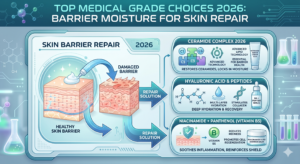
When your “mortar” is weak, moisture escapes and irritants enter. This leads to a “compromised barrier.” In 2026, we have moved beyond simple lotions; we now use bio-identical lipids that mimic this natural mortar to provide instant barrier moisture repair.
Chapter 2: Why Medical Grade Skincare Wins in 2026
Why should you choose medical grade skincare over drugstore alternatives? The answer lies in the concentration and the delivery system.
-
Pure Ingredients: Medical-grade products contain higher concentrations of active ceramides and hyaluronic acid.
-
Deep Penetration: These formulations are designed to reach the deeper layers of the dermis, ensuring your barrier moisture is restored from the inside out, not just on the surface.
-
Clinical Backing: Unlike “over-the-counter” products, medical choices undergo rigorous testing to ensure they repair the skin’s pH balance effectively.
Chapter 3: Top 10 Medical Grade Choices for Barrier Moisture
1. The Gold Standard: Ceramide-Dominant Repair Cream
This is the ultimate choice for those with severely dry or flaky skin. It utilizes a 3:1:1 ratio of ceramides, cholesterol, and fatty acids. This specific ratio has been clinically proven to be the fastest way to restore barrier moisture.
-
Key Benefits: Rapidly heals redness after chemical peels or retinol use.
-
Ideal For: Post-procedure skin and chronic dryness.
2. The Hyaluronic Acid Matrix Booster
Hydration is the first step to barrier health. This serum uses cross-linked hyaluronic acid to provide 72 hours of continuous barrier moisture. It acts as a “moisture magnet,” pulling water from the atmosphere into your skin cells.
3. The Centella Asiatica (Cica) Infusion Balm
In 2026, Cica remains a powerhouse for soothing inflammation. This balm provides a thick layer of barrier moisture that protects sensitive skin from harsh winter winds and urban pollution.
4. Niacinamide & Panthenol Recovery Gel
For those with oily but dehydrated skin, a heavy cream might cause breakouts. This gel formulation provides essential barrier moisture without clogging pores. Niacinamide works to strengthen the lipid barrier, while Panthenol (Vitamin B5) acts as a soothing humectant.
Chapter 4: How to Identify a Compromised Skin Barrier
Are you using the right barrier moisture, or is your skin struggling? Look for these signs:
-
Burning Sensation: Even basic moisturizers sting when applied.
-
Texture Issues: Your skin feels rough or looks “crepey” despite using oils.
-
Breakouts: A weak barrier allows bacteria to settle into pores more easily.
-
Increased Sensitivity: Products that used to work now cause redness.
By choosing a dedicated barrier moisture cream, you can reverse these symptoms in as little as 14 days.
Chapter 5: Professional Salon Treatments for Barrier Repair
Sometimes, at-home products aren’t enough. Visiting a professional beauty salon can accelerate your results. In 2026, the following treatments are trending for barrier moisture restoration:
-
Oxygen Facials: These deliver pure oxygen and vitamins directly into the pores to stimulate healing.
-
LED Light Therapy (Red Light): The red wavelength stimulates ATP in skin cells, encouraging the production of new lipids and strengthening the barrier moisture from within.
-
HydraFacials: A non-invasive way to deep-cleanse while simultaneously infusing the skin with medical-grade barrier moisture serums.
For the best results, always search for a “beauty parlour near me” that specializes in medical-grade aesthetics.
Chapter 6: The 2026 Morning and Evening Routine
To maximize your barrier moisture, follow this dermatologist-approved routine:
Morning Routine (Protection Focus):
-
Gentle Cleanser: Avoid sulfates that strip your natural oils.
-
Vitamin C Serum: Protects the barrier from oxidative stress.
-
Barrier Moisture Cream: Apply while the skin is slightly damp.
-
SPF 50+: The sun is the #1 enemy of your skin barrier.
Evening Routine (Repair Focus):
-
Double Cleanse: Use a cleansing balm followed by a water-based cleanser.
-
Barrier Repair Serum: Look for peptides and ceramides.
-
Heavy Barrier Moisture Mask: Leave on overnight to lock in nutrients.
Chapter 7: Lifestyle Choices for a Resilient Barrier
Inspired by the lifestyle of Cindy Crawford, true beauty is holistic.
-
Diet: Consume high amounts of Omega-3 fatty acids (Salmon, Chia seeds) to build your internal lipid supply.
-
Hydration: Drink at least 3 liters of water to support your barrier moisture levels.
-
Humidity: Use a humidifier in your bedroom to prevent the air from stealing moisture from your skin.
Chapter 8: Frequently Asked Questions (FAQ)
Q: Can I use retinol if my barrier is damaged? A: No. You should stop all active acids and retinols and focus solely on barrier moisture for at least 2 weeks until the stinging stops.
Q: What is the difference between a moisturizer and a barrier cream? A: A regular moisturizer just adds hydration. A barrier moisture cream actually contains the lipids (ceramides) needed to “fix” the skin’s protective wall.
Q: Is medical grade skincare really worth the price? A: Yes. For barrier repair, the purity and molecular weight of the ingredients in medical grade skincare are far superior to mass-market brands.
Chapter 9: Detailed Deep-Dive into the Top 10 Barrier Moisture Products
To ensure your barrier moisture is fully restored, we have analyzed the top 10 medical-grade formulations of 2026. Each of these represents the pinnacle of medical grade skincare.
1. SkinCeuticals Triple Lipid Restore 2:4:2
This is widely considered the “Holy Grail” of barrier moisture repair.
-
The Science: It features a unique lipid ratio of 2% pure ceramides, 4% natural cholesterol, and 2% fatty acids.
-
Why it works: As we age, our lipid production slows down. This cream doesn’t just hydrate; it refills the “mortar” between your skin cells. It is clinically proven to improve skin smoothness by 66% in 8 weeks.
-
Best For: Mature skin and those using high-strength retinoids.
2. Zein Obagi (ZO) Skin Health Recovery Cream
A staple in any professional beauty salon, ZO Skin Health is known for its aggressive yet effective results.
-
The Science: It uses ZCORE™ complex, which consists of a biomimetic tetrapeptide and sweet yellow clover to support the anchoring of the dermo-epidermal junction.
-
Why it works: It provides a calming effect on irritated skin while simultaneously strengthening the barrier moisture levels.
-
Usage: Ideal for post-procedure recovery after laser or chemical peels.
3. EltaMD Barrier Renewal Complex
If you are looking for medical grade skincare that is fragrance-free and non-comedogenic, this is it.
-
The Science: It incorporates five types of ceramides and enzymes that promote skin cell turnover without irritation.
-
Why it works: It uses a “Squalane” base, which mimics the natural sebum found in human skin. This allows the barrier moisture to feel light yet incredibly nourishing.
4. Skinbetter Science Trio Rebalancing Moisture Treatment
This product won multiple awards in 2025 and remains a top choice in 2026 for its “Triple Action” approach.
-
The Science: It focuses on high-performance hydration, supporting the skin’s natural moisturizing factor (NMF), and protecting the barrier moisture against environmental stress.
-
The Result: It creates a “glass skin” effect while keeping the barrier rock-solid.
Chapter 10: The Ingredient Dictionary (Science of Barrier Moisture)
To understand barrier moisture, you must recognize the “Hero Ingredients” on the back of the bottle.
-
Ceramides (1, 3, and 6-II): These are the “glue” molecules. Without them, your skin barrier literally falls apart.
-
Squalane: A stable version of Squalene. It is an antioxidant that prevents UV damage and provides intense barrier moisture without a greasy feel.
-
Centella Asiatica (Cica): Often called “Tiger Grass,” this herb heals wounds and reduces redness instantly.
-
Panthenol (Pro-Vitamin B5): A humectant that pulls moisture into the skin while acting as an anti-inflammatory agent.
-
Niacinamide (Vitamin B3): Increases the production of ceramides and helps fade the dark spots left behind by acne.
Chapter 11: Barrier Moisture for Different Skin Types
-
Chapter 11: Barrier Moisture for Different Skin Types
Barrier moisture is essential for every skin type, not just dry skin. In 2026, skincare experts increasingly emphasize that a healthy skin barrier helps maintain hydration, comfort, balance, and long-term skin health regardless of whether the skin is oily, sensitive, combination, or acne-prone.
The skin barrier acts as a protective shield that helps prevent:
- Moisture loss
- Irritation
- Environmental damage
- Dryness
- Sensitivity
However, different skin types require different approaches to maintaining healthy barrier moisture.
Barrier Moisture for Dry Skin
Dry skin often struggles to retain enough moisture naturally. When the skin barrier becomes weakened, dryness may become worse and lead to:
- Flaking
- Tightness
- Rough texture
- Itching
- Increased sensitivity
Best Barrier Moisture Ingredients for Dry Skin
People with dry skin often benefit from:
- Ceramides
- Hyaluronic acid
- Glycerin
- Squalane
- Shea butter
Rich creams and nourishing moisturizers are commonly recommended to help support long-lasting hydration and barrier repair.
Recommended Barrier Care Tips for Dry Skin
- Use gentle cream cleansers
- Avoid over-exfoliation
- Apply moisturizer on damp skin
- Use overnight hydration creams
- Avoid harsh alcohol-based products
Barrier Moisture for Oily Skin
Many people with oily skin mistakenly avoid moisturizers because they fear increased shine or breakouts. However, oily skin can still become dehydrated and develop a damaged skin barrier.
When oily skin lacks hydration, it may produce even more oil to compensate.
Best Barrier Moisture Ingredients for Oily Skin
Lightweight hydration ingredients often work best, including:
- Niacinamide
- Hyaluronic acid
- Panthenol
- Gel-based moisturizers
- Lightweight ceramides
Recommended Barrier Care Tips for Oily Skin
- Choose oil-free moisturizers
- Avoid harsh stripping cleansers
- Use lightweight hydration layers
- Limit excessive exfoliation
- Focus on balanced hydration
Healthy barrier moisture may help oily skin appear calmer and more balanced over time.
Barrier Moisture for Sensitive Skin
Sensitive skin often reacts more easily to environmental stress and strong skincare ingredients.
A weakened skin barrier may increase:
- Redness
- Burning
- Irritation
- Dry patches
- Product sensitivity
Best Barrier Moisture Ingredients for Sensitive Skin
Gentle barrier-support ingredients often include:
- Ceramides
- Colloidal oatmeal
- Aloe vera
- Panthenol
- Fatty acids
Recommended Barrier Care Tips for Sensitive Skin
- Use fragrance-free skincare
- Keep routines simple
- Avoid strong exfoliants
- Introduce active ingredients slowly
- Prioritize calming moisturizers
Minimal skincare routines are often safest for sensitive skin types.
Barrier Moisture for Combination Skin
Combination skin typically experiences both dryness and oiliness in different areas of the face.
For example:
- Oily T-zone
- Dry cheeks
- Uneven hydration levels
Best Barrier Moisture Strategies for Combination Skin
Combination skin often benefits from balanced products that provide hydration without feeling too heavy.
Helpful ingredients may include:
- Hyaluronic acid
- Niacinamide
- Lightweight ceramides
- Gel-cream moisturizers
Recommended Barrier Care Tips for Combination Skin
- Use lightweight moisturizers
- Avoid aggressive cleansers
- Layer hydration carefully
- Adjust skincare seasonally
Balanced barrier moisture may help combination skin feel more comfortable and even.
Barrier Moisture for Acne-Prone Skin
Acne-prone skin is often treated with strong active ingredients that may weaken the skin barrier over time.
Common acne treatments like:
- Salicylic acid
- Benzoyl peroxide
- Retinoids
can sometimes cause dryness and irritation when overused.
Best Barrier Moisture Ingredients for Acne-Prone Skin
Helpful ingredients often include:
- Niacinamide
- Ceramides
- Panthenol
- Lightweight moisturizers
- Non-comedogenic hydration products
Recommended Barrier Care Tips for Acne-Prone Skin
- Avoid over-cleansing
- Use gentle moisturizers daily
- Reduce over-exfoliation
- Focus on calming hydration
- Introduce strong actives gradually
A healthier skin barrier may improve skin comfort while supporting acne routines more effectively.
Seasonal Barrier Moisture Needs for Different Skin Types
Weather changes can strongly affect barrier moisture levels.
Summer Barrier Moisture Tips
During hot weather, many people prefer:
- Lightweight moisturizers
- Gel hydration
- Cooling skincare products
- Oil-free sunscreen
Winter Barrier Moisture Tips
Cold weather often requires:
- Rich moisturizers
- Barrier creams
- Deep hydration masks
- Extra ceramide support
Adjusting skincare routines seasonally may help improve overall skin comfort.
Why Personalized Barrier Care Matters
No single skincare routine works for everyone. Barrier moisture needs depend on:
- Skin type
- Climate
- Age
- Lifestyle
- Active ingredients used
- Environmental exposure
Understanding personal skin needs is often more important than following viral skincare trends.
Use a lightweight lotion on the T-zone and a heavy barrier moisture cream on the cheeks.
Chapter 12: Comparing DIY vs. Medical Grade Solutions
Many influencers suggest using kitchen oils like Olive Oil or Coconut Oil for barrier. However, in the world of medical grade skincare, this is highly discouraged.
-
Molecular Size: Olive oil has large molecules that sit on top of the skin and clog pores. Medical-grade products are micronized to penetrate deep into the dermis.
-
Purity: Kitchen oils are not pH-balanced for the face. A professional beauty salon will always recommend products that maintain the skin’s “Acid Mantle” (pH 4.5–5.5).
-
Stability: Medical products are stabilized in lab environments to ensure the ingredients don’t oxidize and cause more free radical damage.
5 thoughts on “Best barrier moisture for skin repair: Top Medical Grade Choices 2026”